Tuesday, March 4, 2014

Why Our Children Behave As They Do

Having three sons close in age, I realized that they were each his own person, unique yet often similar.  I knew this came not only from birth position and heredity, but from their individual temperaments, rate of growth and milestone achievements, and desires for independence and feelings of trust.  Family atmosphere and values, exposure to good role models, and methods of parenting all have an influence on who our children become.


Respecting each child as he navigates his new world is important, and our setting boundaries and dealing appropriately with his efforts are very important.  When children have boundaries, they have all the freedom between those boundaries and know what is acceptable.  When we don't set boundaries, or the boundaries change with our moods, then children will have to test us to see what is okay at that moment.  This sense of uncertainty lends itself to insecurity on the part of the child who may become withdrawn or develop an "anything goes" attitude. Neither is what we would want for our child, especially because we are the cause of the behavior.  Just as we react to our children's behavior, they react to ours.  Let me give you some examples of things that worked for us:

     The first time we took our sons to the mall, we told them ahead of time what was expected
      in their behavior and informed them that we would take them back home if they did not
      follow these boundaries.  (We lined up a babysitter in case we needed to do that.)  After about
      fifteen minutes, they began testing the boundaries.  We got them together, took them back to
      the car and home, picking up the babysitter on the way.  Then we went back to the mall without
      them.  That was the only time we had to do that!

      At the movies, we would sit the children in the row in front of us.  That way we could quietly
      talk with each other if desired, and they still felt a sense of freedom.  Now as adults, they have
      often complained that other parents needed to control their children rather than let them run up
      and down the aisles and make noise. 

     At meal time, we had the rule that you taste everything on the table since your taste buds
     change over time, but you only had to eat more of each as you wanted.  If they chose not to
     eat, we would refrigerate the food for later that night, but no dessert if dinner was not eaten.
     There was no anger or degradation (like moving them to a different area until they were done.)

     For instance, I did not allow cussing, so I would call them "bathroom words" and told my
     sons that they could say them in the bathroom.  That took the excitement out of saying them
     and still gave them some sense of control within our boundaries.

     Physical fighting is something else I did not like. If they started fighting near me, I would
     leave the room.  Often, that stopped it, but if they followed me into another room, I told them
     to go outside, or use pillows, or go hit the bean bag toy made for "bopping."  Hitting each
     other was not acceptable.  I think that saying, "Boys will be boys" is just an excuse for
     allowing bad behavior.
   
To help me understand what is and isn't misbehavior, I took parenting courses and read a lot of parenting books, back before blogs!  One of my parenting lifesavers was a book of helpful strategies called Parenting Young Children.  It was based on Systematic Training for Effective Parenting (STEP) for parents of children under six. The text and course are products of Don Dinkmeyer, Ph.D., Gary D. McKay, Ph.D., and James S. Dinkmeyer, M.A. and guided parents in many aspects of understanding young children and why they behave as they do.  Through their research, I came to recognize the goals of misbehavior and how to help my sons gain their goals in positive ways. I will share my perspective of the wonderful knowledge provided in the book.

Children tend to misbehave for one of four reasons:  attention, power, revenge, or as a display of inadequacy.  This can usually be recognized by how it effects you, the parent.  Simplistically put, if you are annoyed, it is probably attention. If anger is your emotion, then the child is likely going for powerRevenge makes us feel emotionally (and possibly physically) hurt.  Whereas, with display of inadequacy, we feel despair.  The last action involves passive behavior  since the child does nothing.  The first three can be passive, but usually involve active behavior on the child's part.

Here is an example:


In this set of pictures, the newspaper photographer labels my son's actions as defiance.  I had told my son to leave my sunglasses alone, and he chose to take them out, put them on, and stick out his tongue at me.  I was annoyed at the action, and did get angry when I couldn't find my class ring in the beach bag when we got home.  (I went back to that spot on the weekend and found my ring sticking up in the sand!) Now, was his behavior one for attention or power or revenge?  Or was he just being a two-year-old with a desire to put on my glasses?  I believe the latter - just part of being a preschooler, although we did discuss the use of his tongue toward me and that he needs to listen to what I say!

But when the behavior is misbehavior, we as a parent can follow some general guidelines for dealing with it, based on the goal.  We can avoid acting the expected way, thus not reinforcing the goal.  If the expected payoff isn't there, the child may change his or her perspective. If the child is seeking attention, ignore the behavior at that time, but provide attention at another appropriate time. This involves changing both our behavior and our feelings.  We can't act hurt or react to the child, or it will negate our goal of stopping the misbehavior. As you redirect the misbehavior, strive to find a positive goal to encourage.  As the STEP authors wrote,  "Encouraging helpfulness and social interest can help refocus that drive for attention in a way that is useful to both the child and others."  Involve them in some way to give them attention when possible.  Mine seemed to want attention when I was busy in the kitchen.  Therefore, I let them peel carrots, pick the potatoes, wash items I didn't need to use anymore, set the table, and even lick the icing out of the pan!


If the child is seeking power, withdrawal from the conflict and try to stay calm. Let the child experience the consequences of his actions, whether these consequences happen naturally or are logical consequences you have put in place.  If the child throws his food on the floor because he doesn't want to eat it, don't send him to his room without dinner.  Have him clean up the mess he made.  The hunger would be a natural consequence.  Having to clean up the mess he made would be a logical consequence as it is related to correcting the misbehavior.  One mother had trouble getting her child dressed for school in time because the child deliberately delayed his actions.  The mother gathered the child's remaining articles of clothing (shoes, socks, jacket) and had the child finish dressing in the car on the way to school. However, giving children a sense of power can often lessen the negative behavior.  Showing the child three outfits and asking him to chose which outfit he wished to wear empowers him.  All the outfits are acceptable to you and he still gets to chose. This works well with eating vegetables and other foods.  Power can be used positively by developing a sense of responsibility in your child for his own behavior and decisions, a sense of independence and capability in his own skills.

Revenge is a more difficult misbehavior to deal with as you are often hurt and extremely angry, but to stop the cycle, you must not show how badly you are feeling. You need to develop trust and mutual respect in an effort to curtail further negative action. What is the reason for the revenge?  Is it something that can be explained?  Discussing the situation can often shed light on the cause that led to this effect.  Was a promise made that had to be broken because of something over which you had no control?  Explain that and acknowledge how you know it must make your child feel.  Good communication in a respectful manner can reveal a lot about the issue and how best to deal with the revenge and prevent further episodes.  The STEP authors suggest a more useful direction would be to encourage the child's probable strong desire for justice and fairness.  Learning to play and share equally encourages this.

If the misbehavior is recognized as a display of inadequacy, encourage any area of strength and focus on the child's slightest effort or improvement.  Avoid criticism.  Instead, help the child determine what he feels the problem is, and work on small goals as steps to reach the goal that will void the display of inadequacy where possible.  Just as we put training wheels on bicycles until the child has the sense of balance to ride without them, we can walk children through the skills or tasks that are causing the feeling of inadequacy, refocus them in a more positive direction.  Often, withdrawal until another time can often help relieve the sense of frustration.  The authors of STEP state, "...it is important to learn appropriate times to show courage by withdrawing from conflict or dangerous situations." Help your child learn when that is the best choice.

We need to recognize that what works with one child may not work with another since all children are not the same!  But developing a parenting plan, one that both parents can agree on when parenting together, can help in the presenting of a united front that can help us understand our children and guide them in their journey to adulthood.  Enjoy every stage!


Sunday, February 23, 2014

Learning to Swim

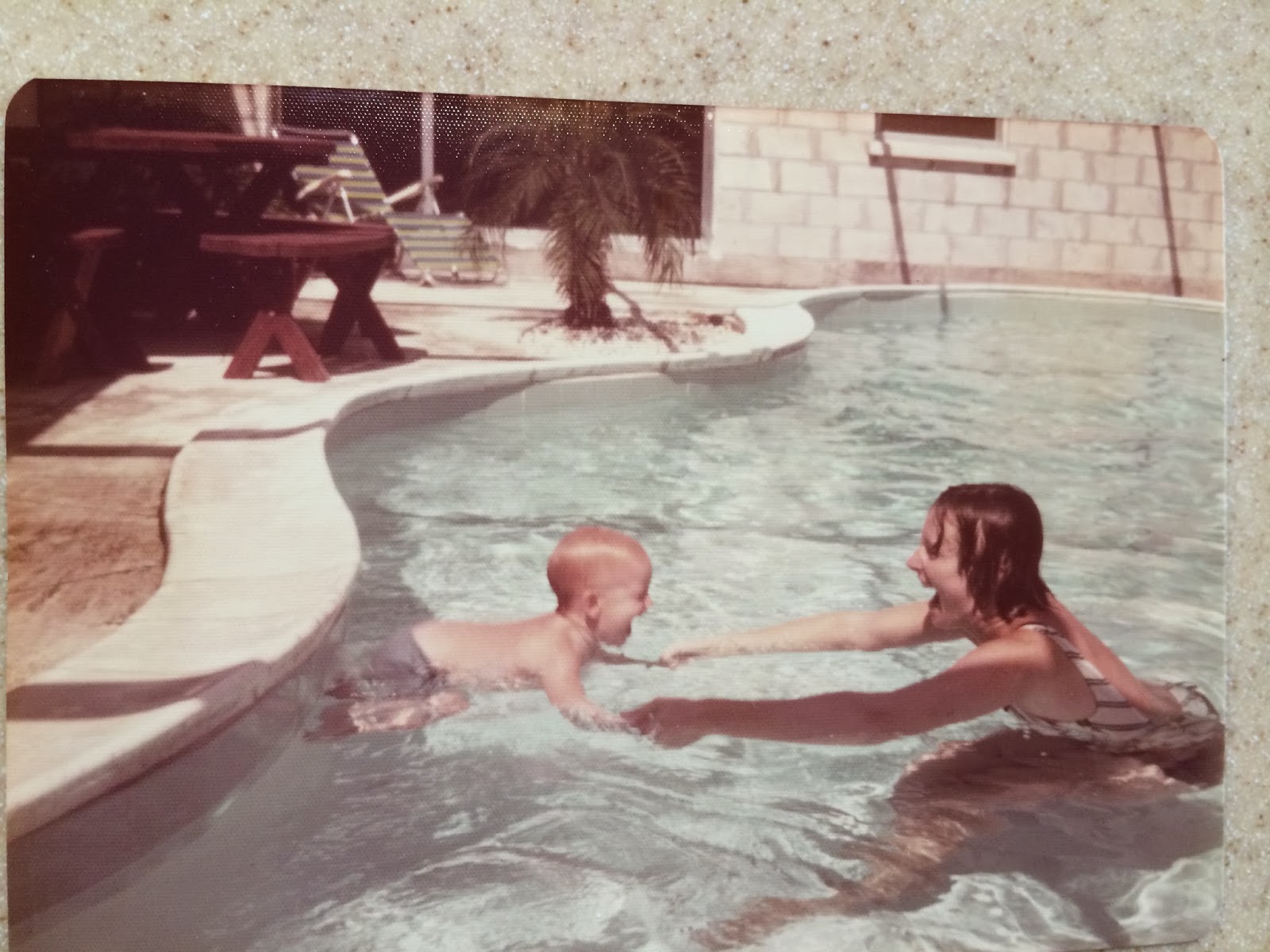
Living in Florida with pools, ponds, and beaches, we wanted to make sure our sons knew how to swim and be safe around water.  When I was pregnant with our second son, I figured it was time for the first, at almost 16 months, to learn how to swim.   First, I  made sure he was comfortable with water besides when in the bath tub.  We did this with various sizes of children's pools over time.

 
Once he reached his comfort zone, we advanced to a real in-the-ground pool.


The technique I used to teach the basic safety moves for accidentally falling into a pool had several steps. I would get each son comfort in the water by slowly moving him around with support under his belly.


Then, I would slowly move him back and forth from me to a friend.


After that seemed to be okay with him, I would hold him facing me and blow gently in his face so he would take a breath of air.  Then, I would gently pull him down under the water and up to me.


Once he grasped the concept of taking a breath of air before going under water, I would turn him around and lift his bottom so he went to the side wall of the pool.  I would make sure he grabbed the side before I removed my hand.  This went on until he could go under and get himself to the side.  The purpose of this was so he would know to get air and shut his mouth and be able to get to the side or find something to hold on to if he ever fell into a pool. He slowly learned to dog paddle and to swim underwater.  Each enjoyed swimming underwater on top of Dad, and jumping off the side to me.


After dog and pool sitting for friends, it appeared all three loved the water.


Using that as our guideline, we put in an above-the-ground pool and built a deck, walkway, and stairs so we could safely use it.  We did put up railings, but did not enclose underneath since it was such a cool place for our dog to lay on those hot days.


We stopped at a lot of water parks on our way to visit relatives in the summer, so it was a handy skill for them to have.  Our oldest was on the high school swim team, the youngest taught paddle boarding and was a white water rafting guide, and the middle just enjoys swimming, so knowing how to swim has been a life-long pleasure for all three. To have that respect for water without the fear was accomplished by taking time to teach them what they needed to know. My method worked for us and we have used it with others successful.  Try it out! 

Climbing on the Way to Walking

Babies usually go through many steps before they actually walk. Once they learn to turn over and back, they learn to scoot and pull themselves across the floor and up, get on their knees and rock, crawl, cruise around the furniture, climb, and eventually walk.  In one of my college courses, I learned that a man named Damon (Delacodo?) was credited with research indicating that these steps were vital in the development of pathways in the brain that influenced the development in many areas.  I have been unable to locate his name in my current research, but according to Anne H. Zachry, a pediatric occupational therapist, in "Why is crawling developmentally important?", there is growing evidence that crawling plays a role in the development of the infant's strength, balance, spinal alignment, visual-spatial skills, and socio-emotional development. Truthfully, all these steps are important in the journey to maturation of body and skills.

Armed with this knowledge from college, I did my best to encourage these interim steps toward walking.  I did use a Johnny Jump-up, bouncy infant seat, and wind-up swing for the times when I could not let them "roam free," but the Jump-up helped in strengthening and muscle development, and all kept them safe from harm while I cooked dinner, folded clothes, or performed other chores which could be done with them in sight.


But once free to move around, they really enjoyed themselves. They would pull themselves up and cruise around in their crib.


I found what they really enjoyed doing was to climb. They would pull themselves up on furniture,


climb the sofa,


front door,

chairs,


shelves and bookcases,


even the dog - who managed to do her share of climbing as well - and of course on Dad!


We did our best to keep everyone safe as they explored and enjoyed their environment on their way to walking. This may be why the climbing desire stayed with them as they grew older. You may find the youngest rock climbing or as a belayer at the rock wall at REI in Seattle.  All are still physically active and healthy.


And to think, it all began with the basic steps in learning how to walk!


Friday, February 7, 2014

Infant Lessons

Just as each delivery is different, each infant is different.  My sons each reached milestones in different orders.  One walked early, one talked early, and one cut his teeth early. This taught me that you need not worry if your child doesn't do the same as your friends' children or his or her own siblings. It is not a competition!  Your pediatrician should know if there is an unusual delay in certain skills and is a good guide if you have concerns. My generation parented using Dr. Spock's Baby and Child Care but there are many excellent sources available in books, magazines, and online.

Weight is an area where there seems to be competition among mothers. My sons were all on the low side of the average "normal" weight so they never looked pudgy.


My mom and others were concerned but the pediatrician said they were healthy and not to worry.  Their paths to food began with breast milk, then formula, next 2% milk since the pediatrician felt the calories were needed but not the fat content, and then baby food.  Because my doctor believed the baby's system needed to be ready to sleep through the night before introducing solids, it was several months before they even got cereal. Then I used a baby food grinder on foods such as peas, cooked chicken livers, cooked apples and peaches, any foods that were used in commercial baby foods.  With three children in three years, every way I could quickly and economically feed them was utilized!

My first son's pediatrician did not believe in giving more than one inoculation at a time.  Even the oral polio vaccine was given singly without any other. I believe this may be a solution for those parents who are concerned about the effects of vaccinations. His belief was that regardless of how it was introduced, each vaccine impacted the body in some way or it wasn't effective. Therefore, one at a time seemed less risky.

My husband had made a beautiful large cradle that could unlock and swing.


We used that for the first until the second came.  We purchased a large crib and moved him to it before son two arrived to prevent any sense of displacement! (Notice how the stuffed animals have their own living quarters!)


Sleeping for three children no longer in cribs in a three bedroom house was eventually accomplished  by making one room a dorm room and another a play room.  My husband made basic box beds with three drawers under the mattress base.


They were very practical beds and fit along three walls of the room. The forth wall had a dresser with a lamp, record player, and clock radio.  The play room had low, sturdy shelves with tubs of the various toys, a child-size table and chairs, a car path mat, desk, and at times a tent among other things.


Toy boxes built by their dad moved from the living area to the playroom.


We spent a lot of time in there together as well as individually.  It lead for a lot of creative activity and made the rest of the house neater since their toys had "their own home."

Bath time was always fun.  With one child, I had no problem keeping him entertained so he enjoyed his time in the water.  When son two came, I would bath him when son one was sleeping until they both were big enough for the bath tub.  Then we used finger paint suitable for the tub, and bubbles for making beards and mustaches.


 When son three arrived, I bought my sons baby dolls that could be washed and fed. When it was time to bath the youngest, I would announce "bath time" and they would get their babies.  We each had a basin and would bath our babies at the same time.  Same with feeding time, except I had to explain to them that they needed to use the baby bottles while I nursed! My sons learned a sense of tenderness and caring that has helped them in their relationships with others so playing with dolls was never an issue. Even when we got our dog, the dolls were just part of their toy and animal collections.


We used clothes passed down from sisters and friends along with the baby shower gifts. Gently used, church, thrift, and consignment shops are also good sources for baby clothes.  I successfully removed mulberry stains from one outfit by boiling it!


One idea my friends and I capitalized on as we raised our children was a baby sitting co-op. Each joining member received 15 index cards stamped with a baby themed stamp. Depending on how many children you were having a member babysit, you would pay for the time with a certain number of these cards.  If you were low on cards, you needed to baby sit a member's child to increase your supply.  No money was exchanged and it gave the children a chance to play with each other.  I used it to be able to take one child to the doctor without having the others there, grocery shop or make an appointment for myself. What a lifesaver!

The infant stage was an enjoyable stage and we have fond memories!


The Baby's Coming!

We all have our delivery stories which we share like hunters discuss their conquests!  I believe part of this is to make the experience a positive one so that we are willing to have another, and part is to receive some acknowledgement for all the effort.
My first son came one week after I went on maternity leave and two weeks before his due date.  My water broke and the doctor said to come in.  This wasn't my doctor whom I had been going to since age 21, but his standby because he was on vacation!  The doctor gave me something for the pain which burned up my arm and knocked me out.  I remember he and the nurse waking me up to push and my asking them to tell the lady screaming to shut up, to which the nurse replied that the screamer was me. The next thing I remember was the nurse pushing on my abdominal area causing me to ask, "Haven't I had this baby yet?"  She said, "Yes, you had a son. I am just making sure you expelled the afterbirth." I was pushed to my room and put in a bed.  After I slept, I awakened to the need to relieve myself.  I sat up and immediately got a horrible headache.  I rang for a nurse who brought me a bed pan and instructed me not to get up since they had given me a spinal, not knowing I would be out for the entire delivery. She left, and it took a considerable amount of time to get any of the various workers who entered and left my room to remove the bed pan.  Apparently, it wasn't in any of their job descriptions!
After three days, I was released to go home.  When my husband went to the clerk to finalize our leaving, she said that our son was not released and must stay. Panic! With much effort to locate a nurse or our doctor to explain, we were told that our son was jaundice and his bilirubin count was too high. They would keep him over night under blue lights, a form of photo-therapy, to get the count down.  As they explained to me, it is not uncommon after two or three days for a baby to be jaundice because of being breast fed, or premature, or due to a blood type mismatch between mother and child. Three for three, so he had to stay and I left with my husband and my "spinal headache."
I pumped my breast milk every few hours during the night and awoke to a call from our pediatrician around 6:30. He had received a call from the hospital's pediatrician that our son had projectile vomited during the night and they had suspected and started treatment for meningitis. This means, best case scenario, he will get better after 13 days of treatment, or worst case, he would die. At this point, I am in tears.  The doctor was heading to the hospital and said he would call us when he got there. Once there, the doctor called to say that our son was heartily sucking on his finger, and was fine, so to get there and nurse him.
Consequently, because they had started treatment, our firstborn had to stay in the hospital for the full thirteen days, and my husband and I went there two to three times a day so I could nurse him. (The rest of the time, he was to be fed the breast milk I continued to extract, but some slipped in formula.) Taking my baby out of the incubator with all the IV and other wires and holding him was awkward but worth it.  We needed to maintain our bonding and I wanted him to get all the benefits of breast milk, and we missed him!  If I had not been dealing with the spinal headache and he were in a room where I could stay, I would have been there all the time.  But that was not allowed.  After a few days, we arrived to find half our son's thick head of hair shaved and an IV inserted because he kept pulling it out.  Natural action for a baby boy! Don't know why I never had them shave off the rest of his hair.


Finally he was released and we could get into a normal routine.  He was such a joy that seven months later, my husband said he would like to try for another.  We stopped using protection and were successful right a way!

Because we had moved after the first son, the second and third sons were born in Florida.  Son number two's birth was so easy compared to the first.  At the end of an evening out with friends, I had what I thought was another Braxton Hicks contraction since it was two weeks from the due date. I went to bed and awoke around 3:30 AM with constipation cramps.  I went to the bathroom and realized when the cramps didn't leave after a bowel movement that I might be in labor.  I woke my husband who grabbed our son while I grabbed my bag.  When we arrived at the hospital, a nurse took me up to be examined while my husband and son waited.  Turns out I was fully dilated and ready to deliver. One nurse told me not to push but the urge was intense. (Are you hearing Prissy from Gone With the Wind saying, "I don't know nothin' 'bout birthin' babies!")  Believe me, my face showed the terror, but the second nurse said to go ahead and push since she had delivered babies before. Then the doctor walked in, took a quick look, and told me to push.  Son two was born!  It was around one hour from when I awoke until he arrived, with 30 minutes of that in the hospital and two minutes of that with the doctor!  The doctor called down to let me speak with my husband, but he wasn't there. Son one had his own bowel movement and we hadn't grab diapers when we left.  As the hospital only had newborn sizes, they had gone home to change diapers thinking I would be awhile! I called him at home and when he answered, I began crying. He asked what was wrong and I shared that we had another son! Our son was very healthy but did have crooked legs due to how I carried him.  That was easily corrected with casts for a short span of time.


Raising two sons so close in age was not really difficult.  In fact, as I was soon approaching 30, we decided to try for a girl.  I had read all this literature on encouraging the female sperm and discouraging the male sperm.  I did the diet, douche, position, and timing and son number three was conceived!  His delivery was not as quick as son number two because he was only 6 days early and therefore a larger baby.  But I was able to have the delivery again without drugs so I could take care of three babies born in three years!  Sons two and three both had the same jaundice and high bilirubin count as son one.  However, since babies only stayed in the hospital one day as compared to the three from before, the pediatricians just kept an eye on them.  Funny incident with son three was the visit by our pediatrician in the hospital.  He had three daughters and knew I had been trying for one.  His comment when he saw me was, "I have just seen your daughter.  She is doing fine, and I will circumcise her tomorrow!" You have to laugh!


Having three boys in just over three years was truly a joy!  When we were done a phase with son three, we were done with that phase be it breast feeding, bottles, diapers, etc.... Their interests were similar and all we did was age appropriate for all three. Very enjoyable time in our lives!  Do you notice the fourth baby in the picture? That little doll and her sisters helped me a lot when taking care of the needs of son number three!  Read about her in the next post.


Thursday, January 30, 2014

About me, the Mom


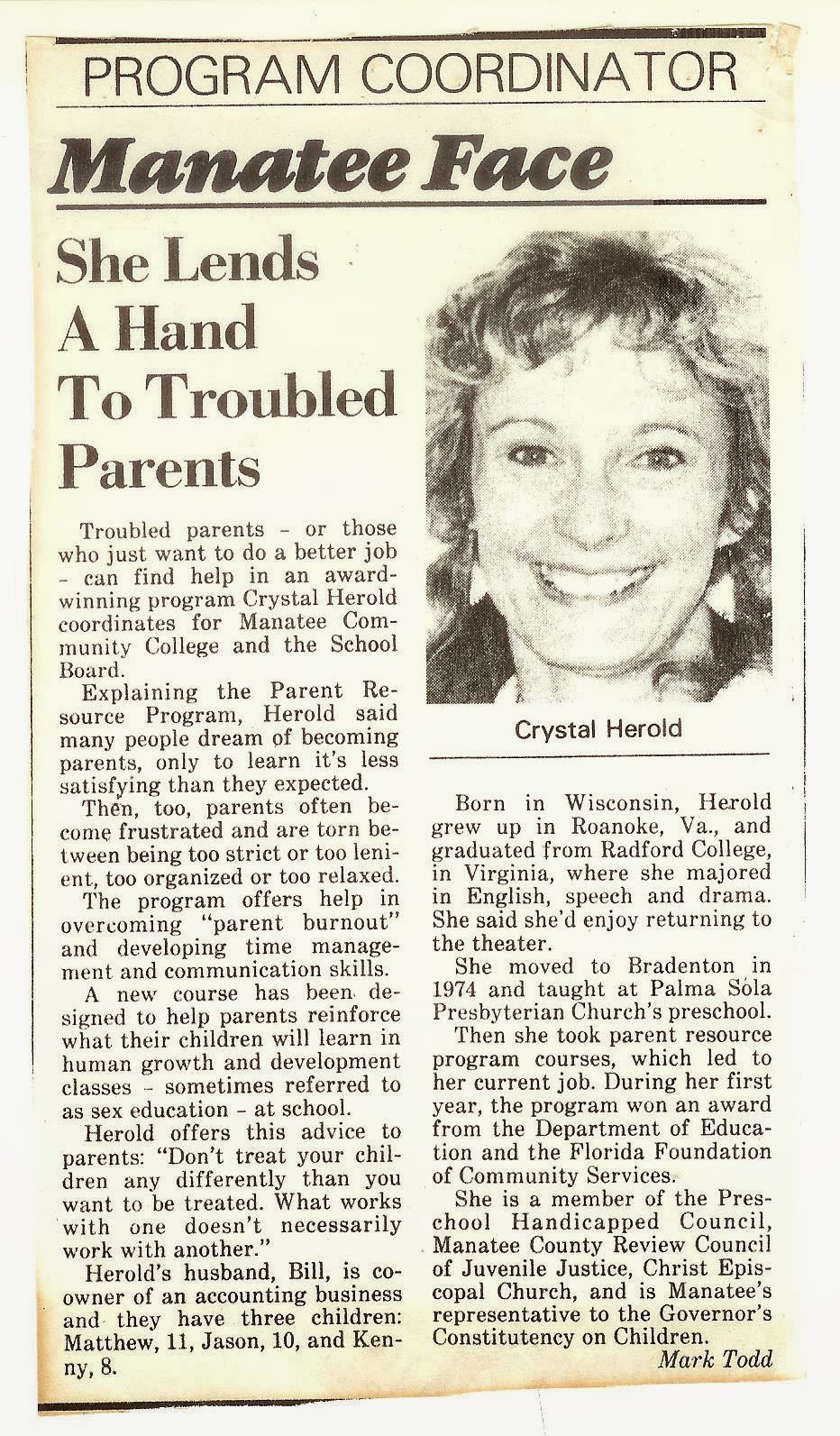
As a mother of three sons, I used my training and education to help guide my husband and me in our parenting.  I have a Bachelor of Arts degree from Radford University with majors in English and Speech & Drama and a minor in Sociology. My Masters of Education from the University of South Florida is in Administration and Supervision with a focus on Reading, and my Doctorate of Education is from the University of Sarasota with a major in Curriculum and Instruction with focuses on Gifted and Learning Disabilities.  However, my strongest training was as the Coordinator of the Parent Resource Program, a joint effort by Manatee Community College (now the State College of Florida) and the Manatee County School Board.


I added this acquired knowledge and experience to my "tool belt" as a teacher when I taught parent education to teenage mothers with their babies at an alternative school, teenage fathers or fathers-to-be at a commitment program, to divorced parents with children as a stipulation in our district's divorce procedures, and as the Parent Ed Specialist for the Early Intervention Program. It aided me as a teacher, drama coach, reading coach, and gifted coordinator, and most importantly as a mother!  But let me set the stage.


At the culmination of my maternity leave after having our first son, I resigned from my job. Our family of three moved to my husband's new job location and I became a stay-at-home mom. Then came sons two and three. To provide them an opportunity to play with others and me an opportunity to be with them and with other adults, I began teaching preschool.  That is where my exposure to the Parent Resource Program's parenting courses began.  Everything seemed so appropriate for our situations as parents.  When the  20-hour-a-week coordinator position became available after my sons were all in elementary school, I applied and got it. This afforded me the opportunity to train with some of the leading writers of parenting books, set up sessions for the parents in our community, write articles, research issues of concern, and speak about them at PTAs, church groups, civic clubs, and other interested parties. When funding for this program ended several years later, we had served over 800 parents that final year and had won two state awards for our outreach into the community. But what I learned was ingrained and became the guide in how my husband and I reared our sons.  They are very well adjusted, successful, and happy adults - and none are living at home or depending on us for support! (This seems to a concern for some of our friends with economy as it is today.)  We love being with them and are continuing to be a part of their lives - with their blessing!  My hope in this blog is that I can offer to other parents some of the tools we found helpful in successfully ushering our children into adulthood.  Not everything will work for everyone, but you will have so viable options to explore.